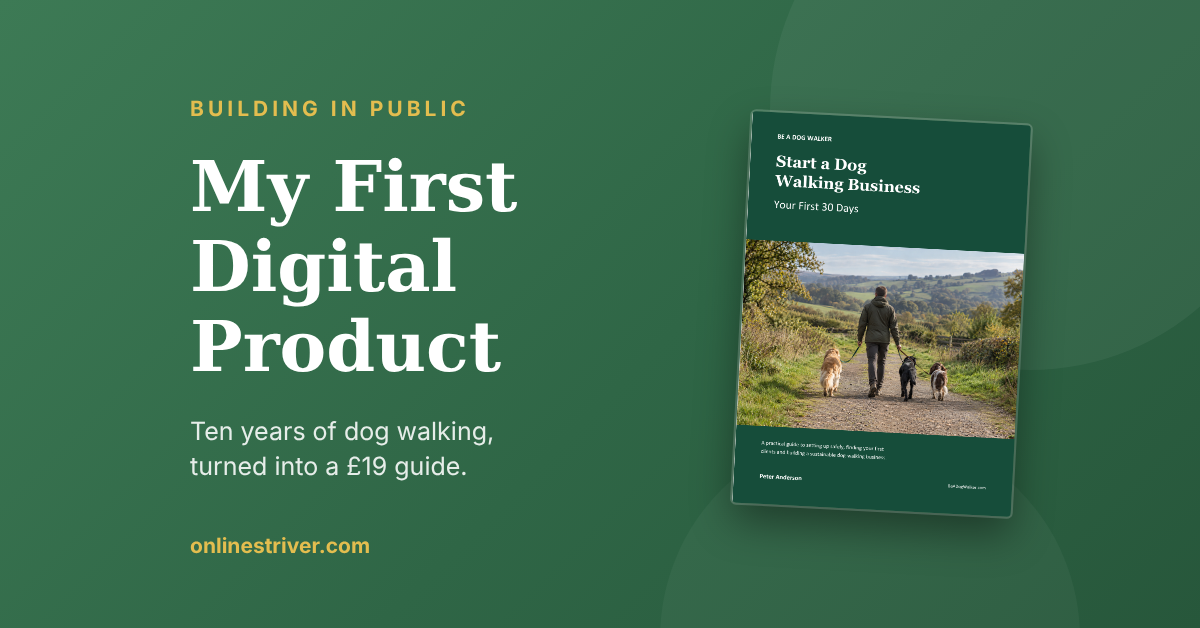
How I Turned 10 Years of Dog Walking into My First Digital Product
My first digital product started with something I was already doing every working day: walking other people’s dogs. After around ten years running Lothian Walkies, I had a head full of practical experience, but no finished book and no clear way to turn those lessons into something someone could buy.
Over 3-4 weeks, I turned that experience into a £19 guide and toolkit, then built a website that could take payment and deliver the files. The difficult part wasn’t just writing. It was getting the knowledge out of my head, making it useful to a beginner and joining the product, website and checkout into one working process.
The site is Be a Dog Walker.
When I first wrote about the launch, the only sale was my own checkout test. That matters. I had proved that the buying process worked, not that I had a successful marketing system. This expanded account explains how I built it and the next experiment I want to run.
The project at a glance
- Starting point: around ten years of professional dog walking experience.
- Product: three PDFs, 55 pages in total, sold together for £19.
- Build period: 3-4 weeks for the original product and website.
- Tools: ChatGPT for interviewing, organising and drafting; WordPress and Kadence for the website; Easy Digital Downloads and Stripe for the buying process.
- Launch test: my own purchase checked payment, the receipt and access to all three PDFs.
- Next step: a focused marketing experiment to reach people considering a dog walking business.
Starting with something I already knew
Through OnlineStriver I’ve been exploring ways to build an online income. The hard part has been deciding where to put my attention. There is no shortage of tools and ideas. Picking one project and finishing it is harder.
Dog walking gave me a clear starting point. I had ten years of real situations to draw on, and lessons that could save a beginner from some of my mistakes.
Choosing your service area is a good example. It sounds like a small decision. Take on customers too far apart and you spend much of your day driving between collections, which eats into your time, your costs and the number of dogs you can fit in.
You understand that much better once you’ve run the business yourself, and it’s exactly the sort of advice I wanted to get down.
Getting the knowledge out of my head
I didn’t start by writing a book. I started with a series of conversations with ChatGPT, where it asked the questions and I answered them from how I actually run my business.
We worked through:
- Finding the first customers
- Choosing an area and setting prices
- Speaking to owners and arranging trial walks
- Managing keys, paperwork and transport
- Introducing dogs to a group
- Planning safe walks and adapting to the weather
- Handling payments and unexpected problems
Answering questions brought out details I would otherwise have skipped. My first customers came through people I knew at my children’s school. Trust grew from existing relationships and word of mouth.
Someone starting today might assume they need an advertising budget. My experience says to look first at the community you’re already part of.
Over time those conversations became what I called a knowledge vault: an organised record of what I’d learned.
The interview approach gave me a smaller job to do each time. Instead of trying to write a whole chapter from a blank page, I could explain one part of the business: what I do, why I do it and what can go wrong. The useful material came from those ordinary decisions.
For example, talking about a first meeting with an owner leads naturally into trial walks, paperwork, keys and expectations. Talking about choosing a route brings up collection times, travel distance and the mix of dogs. Those connections are easy to miss when you only make a list of chapter headings.
I still needed to judge the answers and the draft. ChatGPT could help me organise what I said, but it hadn’t walked my routes or dealt with my customers. I wanted the finished guide to sound like practical help from someone doing the work, with clear limits around what was personal experience.
Turning the conversations into a guide
A pile of interview answers isn’t a guide. Related points had to be pulled together, repetition cut, and everything put in an order a beginner could follow.
ChatGPT helped me capture, organise and draft the material. The examples, decisions and lessons came from running Lothian Walkies.
I also wanted to separate my own way of working from rules everyone must follow. I do two walks a day, Monday to Friday, with six dogs per walk. That suits my business. What suits yours will depend on your experience, the dogs, your transport and what your local council and insurer allow.
The editing job was to turn that record into a route through the first month. A beginner needs to know what to decide before taking a dog out, what to prepare before meeting an owner and what can be improved after the business starts. Simply putting the conversations into a PDF would have left too much work for the reader.
I also needed the advice to be usable away from the page. Reading about service areas or pricing is one thing. Sitting down and deciding your own area, costs and approach is another. That was the reason for making a planner alongside the main guide, rather than trying to make one book do every job.
What’s in it
For £19 the buyer gets three PDFs, 55 pages in total:
- Start a Dog Walking Business: Your First 30 Days (31 pages). The main book.
- Be a Dog Walker Business Planner (10 pages).
- Dog Walking Photos and Social Media (14 pages). A bonus starter kit for taking better phone photos, making short videos and earning trust in your area.
Each PDF has a different job. The 31-page main guide explains the first steps and the decisions behind them. The 10-page business planner gives the reader somewhere to work through their own plans. The 14-page photos and social media starter kit helps with showing the real service and building trust.
That division made more sense to me than adding pages just to make the product look bigger. Someone starting a dog walking business needs practical help they can return to. They should be able to read an explanation, make a decision and then use the relevant part of the toolkit.
The files also needed checking as downloads. A document looking fine while I was working on it wasn’t enough. The finished PDFs had to open properly, contain the promised material and be the same files the buyer received. The real purchase test later became the final check of all three together.
Building somewhere to sell it
Next came beadogwalker.com. The site had to explain who the guide is for, what’s in it and how to buy it.
ChatGPT and I worked on the sales page, the photographs and the route from payment to download. I used photos from my own walks, so visitors can see the real dogs and the real business behind the guide.
I built the site in WordPress using Kadence. Easy Digital Downloads manages the digital product and download process, with Stripe handling the card payment.
This was more work than putting a page online. We went through the checkout information, where the privacy policy appears, the delivery wording and the guarantee wording. I also had to sort out problems with the domain, SSL and the business email.
Those details are easy to underestimate when you’re planning a product. All of them have to work before a stranger will hand over £19.
The site needed to answer the questions I would have as a buyer: is this for someone at my stage, what exactly do I receive, what will it help me do and what happens after payment? The cover and photographs could help introduce it, but the words had to make the offer clear.
Using my own walking photos mattered for the same reason as using my own examples in the guide. They connected the product to an actual dog walking business. I wanted visitors to see where the advice came from, rather than finding a sales page that could have been written about any subject.
I also had to think about the site on a phone. Someone could arrive from a social post, read the description and decide to buy without ever using a computer. The product explanation, buttons and checkout needed to make sense as one journey.
Joining WordPress, Easy Digital Downloads and Stripe
I needed to understand the separate jobs each part was doing. WordPress and Kadence presented the offer. Easy Digital Downloads held the product, price and download files. Stripe processed the payment. The customer should experience that as one straightforward purchase, even though several parts are involved behind the scenes.
The practical question was simple: if someone paid £19, would the order be recorded correctly and would they receive the right downloads? Connecting a payment provider was only part of the answer. The product settings, receipt and access to the files needed to agree with what the sales page promised.
There was also a difference between testing the setup and knowing the live process worked. I wanted to see a real payment leave my account, appear against the correct order and lead to usable files. That is why I did the purchase test rather than relying only on the appearance of the checkout.
The technical work I had underestimated
The domain, SSL and business email problems were separate jobs from making the guide. None of them added another page to the product, but each could affect whether somebody trusted the website or received the information they needed.
I had to look at the whole route through the site, not just the main sales page. Checkout information needed to be clear. The privacy policy had to be accessible. Delivery and guarantee wording needed to fit what the customer was actually buying. Those are easy details to leave until the end, when you are already keen to call the project finished.
Email was another reminder that one successful step does not prove the whole system works. A receipt, a download and an ordinary business-mailbox reply are different things to check. My phone email setup proved troublesome, and I eventually tested sending and replying through Thunderbird.
The lesson for me was to separate the problems. If a file won’t open, check the file and its delivery. If an email doesn’t arrive, check that part of the journey. If the website itself isn’t working properly, deal with the domain or hosting issue before changing the product. Otherwise it is very easy to keep changing the wrong thing.
Testing a real purchase
Before telling anyone, I bought the guide myself at the full £19.
The payment left my account and showed up in Easy Digital Downloads. The right name appeared, the email arrived a few minutes later, and all three PDFs opened.
I also tested sending and replying from the business mailbox. I did that in Thunderbird, after my earlier attempts to set it up on my phone proved troublesome.
At the point covered by the original launch article, that test purchase was my only sale. No customer had bought it yet. I am keeping that distinction here rather than presenting a working checkout as evidence of customer demand.
I followed the purchase all the way through: payment, the order record, the receipt and opening the three PDFs. The receipt took a few minutes to arrive. That wait was worth noticing because a buyer does not see what I see in the dashboard; they only know what appears on the screen and in their inbox.
The test gave me confidence in the transaction and delivery. It did not tell me how many people would want the guide, which message would persuade them or what it would cost to find a customer. Those are marketing questions, and they need their own test.
What I’ve learned so far
Everyday experience is a good place to start. When you’ve done something for years, you forget how many decisions you’ve learned to make. A beginner needs help with things you now do without thinking.
Answering questions is easier than writing. Being interviewed made the job manageable and pulled out practical examples I wouldn’t have thought to include.
Follow the customer journey to the end. A finished PDF and a working sales page are milestones. Payment, the delivery email and file access all need checking too.
Publishing changes the work. Once the product is live, the job becomes helping the right people find it, listening to their questions and improving it from their feedback.
What comes next
Now I need to get the guide in front of people who are thinking about starting a dog walking business.
Each of my three sites has a job. Lothian Walkies is the experience behind the guide. Be a Dog Walker is where people buy it. OnlineStriver is where I write up how it’s going: what works, what needs changing, and the results when there are some.
My next marketing experiment
For the next stage, I want to run a small, focused 30-day test. The question is whether practical advice about starting a dog walking business can bring suitable readers to the guide and produce genuine customer interest. This is the experiment I plan to run, not a result I can report yet.
- Choose one useful topic. I would start with choosing a sensible service area, because it is a real problem I can explain from experience and it connects directly to the guide.
- Publish a helpful article. The article should give enough practical detail to be useful on its own, then show where the guide and planner can help someone work through their own decisions.
- Share it with a relevant audience. I plan to use a small number of appropriate social posts and conversations. In groups, I would follow the rules and ask permission where needed, rather than dropping a sales link everywhere.
- Record the response. I want to note where visits come from, the questions people ask and any genuine purchases. My own tests will stay separate from customer sales.
- Review after 30 days. If few suitable people reach the page, I need to work on distribution. If people visit but do not buy, I need to investigate the explanation, offer or buying process before deciding what to change.
I do not want to change the price, rewrite the whole site and try several new channels at once. Keeping the test small should make it easier to understand what I am learning. I will also record any spending and time involved, rather than treating revenue as profit.
The useful outcome is evidence. That might be a purchase, but it might also be a repeated question that exposes something missing from the page. I will write up what actually happens, including a quiet response if that is the result.
If you’re weighing up your own digital product, this is the question that got me started:
What do you already know from experience that would help someone taking their first steps?
If you’re not sure, my niche-finder quiz is a quick way to start narrowing it down.
And if your first step happens to be starting a dog walking business, you can find my guide at Be a Dog Walker.
What could you build from your own experience?
If this story has prompted an idea, my free Starting Point Workbook will help you explore it. Work through your experience, compare business models and choose one small test, with practical exercises and a 30-day action plan.
Receive the workbook and practical OnlineStriver emails. Unsubscribe at any time.
